Chain of Thought asks the model to think step by step. It’s been the dominant prompting technique since 2022 and it works — for problems that have a single best path. For problems where the first path might be the wrong one, it has a blind spot: it commits too early.
Tree of Thought (ToT) fixes that. Instead of one chain of reasoning, the model explores multiple branches simultaneously, evaluates them, and backtracks when a branch is unproductive. The improvement on hard reasoning tasks can be dramatic. But most people don’t use it — partly because it’s more complex to set up, and partly because the standard chat interface is the wrong shape for it.
What is Tree of Thought prompting?
Tree of Thought is a prompting framework introduced in a 2023 paper by Yao et al. The core idea: instead of generating a single chain of reasoning steps, prompt the model to generate multiple intermediate “thoughts” at each step, evaluate which are most promising, and continue only the promising ones. Unproductive paths are pruned. The search space explored is a tree, not a line.
The model acts as both the generator (coming up with candidate thoughts) and the evaluator (judging which are worth pursuing). A third role — the search controller — decides when to go deeper, when to backtrack, and when to stop. Depending on implementation, the search controller can be the model itself, an external script, or the human.
In practice, “Tree of Thought” is used loosely to describe any prompting approach that has the model consider multiple reasoning paths rather than committing to one. The strict academic version uses explicit search algorithms (BFS, DFS); the practical version often just asks the model to brainstorm candidates, evaluate them, and pick the best.
Chain of Thought vs Tree of Thought
The difference isn’t complexity — it’s structure.
Chain of Thought (CoT) asks the model to reason linearly: step 1, step 2, step 3, answer. It surfaces the reasoning so you can see where it went. The model commits to each step before generating the next. If step 2 is subtly wrong, the rest of the chain propagates that error forward.
Tree of Thought (ToT)asks the model to hold multiple partial solutions open simultaneously: “generate three possible next steps, evaluate each, continue the most promising.” The model can backtrack if an approach dead-ends. This is closer to how humans actually solve hard problems — we don’t commit fully to the first approach we think of.
CoT is the model narrating a single path. ToT is the model exploring a map and choosing a route.
The tradeoff: ToT requires more tokens, more turns, and more prompt engineering. For simple factual questions or straightforward tasks, it’s overkill. CoT is usually enough. ToT shines when the problem space has multiple viable approaches and committing to the first one is risky.
When ToT outperforms standard prompting
The original paper demonstrated large improvements on three benchmark tasks: Game of 24 (mathematical reasoning requiring backtracking), Creative Writing (generating a coherent passage across multiple constraints), and Mini Crosswords. What these have in common: wrong early choices derail the whole solution, and the search space benefits from exploration.
Practical situations where ToT is worth the setup cost:
- Multi-step planning with constraints. Writing a project plan where some options are mutually exclusive, or a technical architecture where choosing one approach precludes another.
- Creative work requiring constraint satisfaction. Writing that has to hit multiple tonal, structural, and content requirements simultaneously. The model needs to hold all constraints as it explores rather than satisfying them one at a time.
- Debugging with multiple competing hypotheses. When you have three possible causes and want to explore each before deciding which to investigate, ToT lets you run the exploration in parallel rather than sequentially.
- Decision analysis. Evaluating a strategic decision where each option has different downstream implications — you want to model each path independently before comparing.
For tasks with a clear single answer, straightforward step-by-step CoT is usually better. ToT’s advantage comes specifically from backtracking and parallel exploration.
How to apply Tree of Thought manually
You don’t need a custom implementation to use Tree of Thought. Here are three prompt patterns that work in any chat interface:
The brainstorm-then-evaluate pattern
Ask for multiple candidates in one turn, then ask the model to evaluate them before picking one:
“Give me three distinct approaches to [problem]. For each, explain the core logic and the main risk. Then tell me which you’d pursue first and why.”
This is the simplest ToT approximation. The model generates candidates, evaluates, and selects — all in one response. Limitation: you see the result of the evaluation, not the reasoning that led to it being discarded.
The explicit backtracking pattern
Let the model commit to an approach, then ask it to reconsider before continuing:
“Before continuing with that plan: what’s the strongest argument against it? Is there an alternative approach you initially considered and ruled out that might actually be better?”
This surfaces discarded paths. Models often have a “first response commitment” tendency — this prompt interrupts it.
The step-by-step evaluation pattern
For longer chains, add evaluation checkpoints:
“At each step, before continuing, list one alternative path you could take instead. Briefly assess whether it’s worth exploring, then continue on the main path.”
This makes the tree structure explicit in the response. Slower, but the reasoning is visible.
ToT on a canvas, not a scroll.
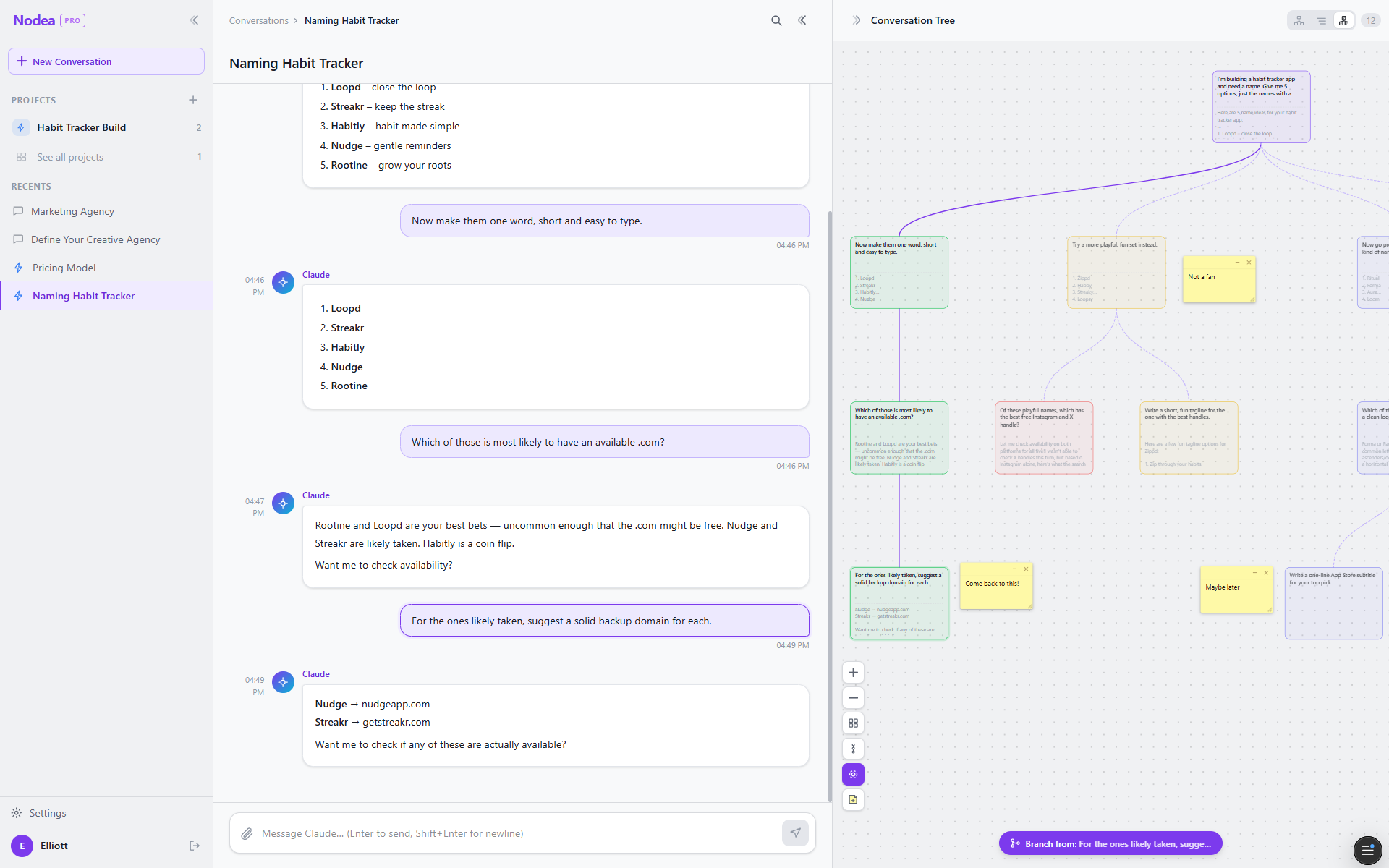
Nodea lets you run ToT exploration across real branches — each path is its own conversation, visible on the tree.
Try Nodea free →The interface problem
Here’s the tension: Tree of Thought is, by definition, a non-linear reasoning process. But the chat interface you’re using is linear. The disconnect creates three practical problems.
Branches collapse into a single thread
If you use the brainstorm-then-evaluate pattern, all three candidate paths appear in one response. You see the winner, but you can’t continue exploring the alternatives — they’re text in a response, not live branches. Once you continue the conversation, those paths are gone.
Context accumulates across the exploration
If you run multiple candidate paths in the same thread — first trying approach A, then approach B — the model’s context for approach B now includes all of approach A’s content. The paths aren’t independent. The model may subtly mix context from one path into another, or resist the backtrack because the failed approach is still in its window.
You can’t compare branches
Even if you successfully explore two paths, you can’t read them side by side. You scroll up and down a single thread. The comparison lives in your memory, not on the screen.
Tree of Thought + a branching interface
A branching chat interface is the natural complement to Tree of Thought prompting. The connection is direct: ToT is a technique where the model explores a tree of reasoning. A branching interface is an environment where the user explores a tree of conversations.
When you use ToT in a branching interface like Nodea:
- Each candidate reasoning path becomes its own branch. The branches are independent — the model context for branch B doesn’t include branch A’s content.
- You can continue each path as a live conversation, not just as text in a response. Ask follow-up questions on the approach the model suggested and evaluate it more deeply before comparing.
- The full tree is visible on a canvas. You can see which paths were explored, which were abandoned, and the relative depth of each.
- Backtracking is literal: click the node you want to branch from and start a new conversation from that point. No workarounds, no re-explaining.
The result is that the ToT technique, which is cumbersome to run in a linear chat, becomes the default way of working. The branching AI chat guide covers the full picture of how branching interfaces work.
FAQ
Do I need to code anything to use Tree of Thought?
No. The brainstorm-then-evaluate and explicit backtracking patterns work with any chat interface through plain prompting. The academic implementations that use BFS/DFS search algorithms require code, but practical ToT doesn’t.
Does Tree of Thought always give better results?
No. For simple tasks — factual questions, clear-step instructions, basic summarization — Chain of Thought or no special prompting at all is faster and cheaper. ToT adds value specifically when the problem benefits from exploring multiple approaches before committing.
Is Tree of Thought the same as “asking for alternatives”?
Related but different. Asking for alternatives (“give me three options”) generates candidates. ToT additionally asks the model to evaluate each option, continue the most promising, and backtrack from unproductive paths. The evaluation and backtracking steps are what distinguish it from a simple brainstorm.
Which models support Tree of Thought best?
Any capable model can follow ToT-style prompting. In practice, models with strong instruction following and long-context handling work best — Claude (Sonnet and Opus) and GPT-4 class models are the common choices. The technique is model-agnostic; the quality of evaluation reasoning varies by model.
What’s the difference between Tree of Thought and ReAct?
ReAct (Reason + Act) interleaves reasoning with external tool calls — the model reasons, takes an action (search, code execution, etc.), observes the result, and repeats. Tree of Thought is purely internal: it explores reasoning paths without external actions. They’re complementary; you can combine them in agentic systems.