Research with an AI almost always starts the same way: a curious question typed into a chat box. Two hours later you have a transcript with thirty turns, a half-dozen interesting threads you can’t quite remember the order of, and a fading sense of which claims came from which questions. The conversation produced insight; it did not produce something you could defend, share, or build on.
The chaos isn’t a personal failing — it’s baked into the interface. Serious investigation forks. Linear chat refuses to. This guide walks through a research workflow that finally matches the shape of the work.
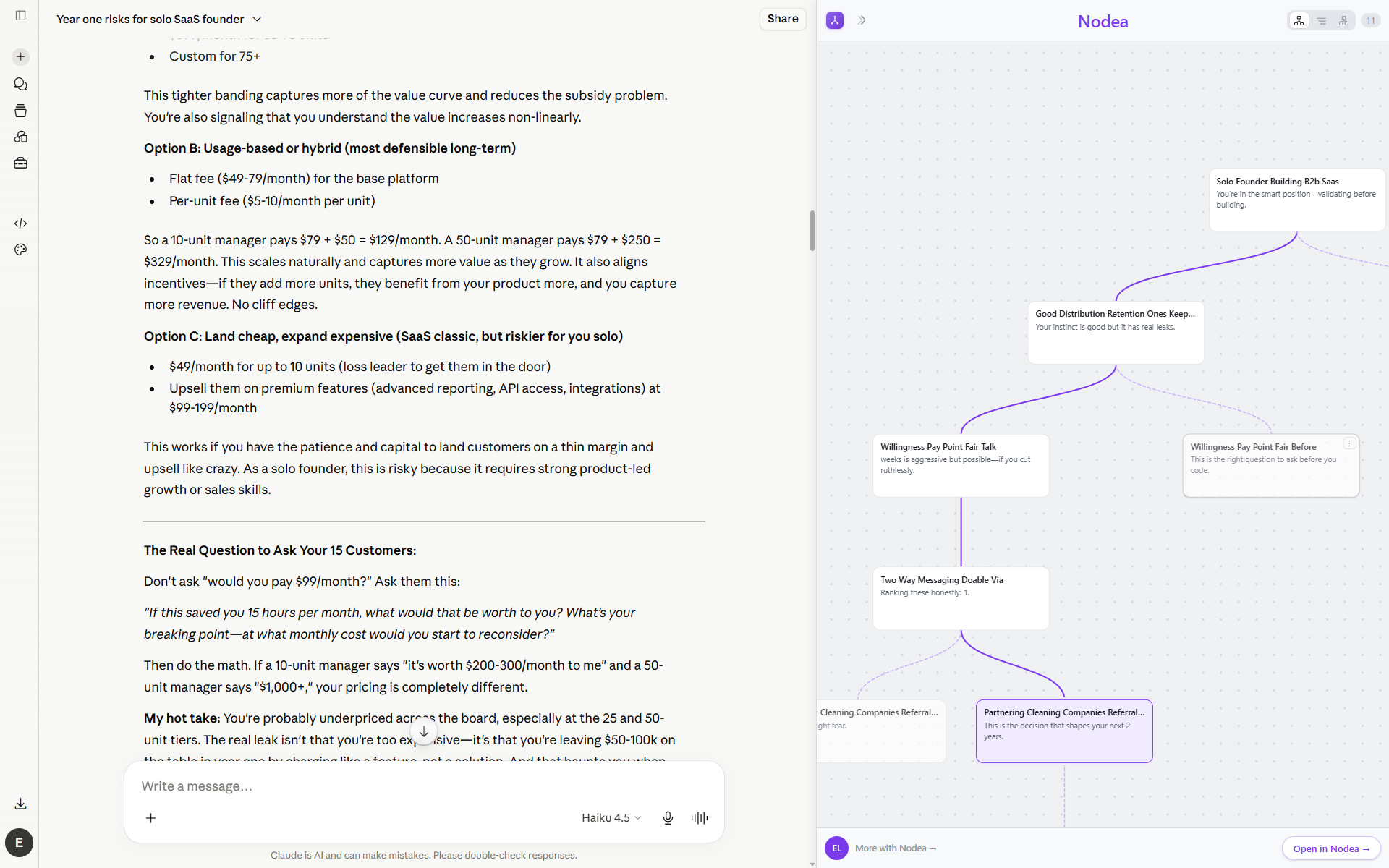
Why AI research tends toward chaos
Three structural problems make AI research messy by default:
- Hypotheses contaminate each other. Once you ask the AI “what about explanation X?”, every subsequent reply is colored by X being in context. Asking about Y after asking about X is not the same as asking about Y from scratch.
- Tangents bury the trunk. A good follow-up question pulls the conversation sideways. The original research question is now ten turns up the scroll and effectively gone. By the end, you’ve answered five related questions and forgotten which one you started with.
- Provenance dissolves. Halfway through, the model says something that becomes a load-bearing claim in your final synthesis. Two days later, you can’t tell whether that claim was the model speaking with confidence, a citation it offered, or your own reasoning that it reflected back. The transcript lost track of where things came from.
You can power through this with discipline — taking notes outside the chat, copying claims into a doc, manually tracking hypotheses. Most people don’t, because the friction is high. So the chaos compounds.
The shape of a well-run investigation
Borrow from how researchers structure work outside of AI. A good investigation has a clear shape:
- A research question stated specifically enough that you’d know whether you’d answered it.
- A set of candidate explanations or hypotheses that, taken together, plausibly span the answer space.
- Independent investigation of each candidate— evidence for and against, sources, counterarguments.
- A synthesis that weighs the candidates and commits to a conclusion (or to remaining open).
Notice the structure: it’s a tree. Root: the question. First-level branches: the hypotheses. Sub-branches: the evidence streams for each hypothesis. This is the shape that works, and the shape that a linear chat box actively fights.
A five-step branching research workflow
Here’s how to run an investigation on a branching canvas like Nodea. The example: a research question is “why did our customer activation rate drop 18% over the last quarter?”
Step 1: Write the question as the root
The root node states the research question as specifically as you can make it, plus the relevant background. Don’t skip this — a vague root produces vague branches.
Research question:
"Why did our customer activation rate (defined as % of new signups who
complete the onboarding flow within 7 days) drop from 62% to 51% between
2026-Q1 and 2026-Q2?"

Background:
- Sign-up volume increased ~30% over the same period (so absolute
  activations went up slightly, but rate dropped sharply).
- No major product change shipped in this window.
- Activation drop appears mostly in new mobile signups; web users are
  roughly flat.
- Marketing acquisition mix shifted toward paid social.
Step 2: Branch a hypothesis per child
From the root, fan out one branch per candidate explanation. Don’t mix them. Each branch starts independent of the others.
- Branch A: Mix shift — paid-social signups have lower intent
- Branch B: Mobile-specific UX regression — the onboarding broke or degraded on mobile
- Branch C: Tracking artifact — the metric measurement changed without us noticing
- Branch D: Seasonality — Q2 historically slower
For each branch, ask the AI to argue the case for that hypothesis given the background. You’ll get four parallel cases, each generated without knowledge of the others.
Step 3: Branch a steel-man and a stress test per hypothesis
On each hypothesis branch, fork two children:
- Steel-man:“what’s the strongest version of this argument? What evidence would I expect to see if it’s true?”
- Stress test:“what evidence would falsify this? What does it predict that we can check?”
This is the part most AI research skips. The default is to accept the first plausible explanation. Forcing each hypothesis to predict things and admit counter-evidence is how you separate explanations that survive contact with reality from ones that don’t.
Step 4: Pull each prediction back to data
Now you have, per hypothesis, a list of predictions and expected evidence. Take those predictions to your actual data — a SQL query, a dashboard, a manual check. You’re no longer asking the AI to reason in the abstract; you’re using its hypotheses as a structured checklist for what to investigate in the real world.
Record what you find as a child node on each branch. If the prediction held: note it. If it didn’t: note that too. The branch that survives the most contact with data is the candidate explanation you should provisionally believe.
Step 5: Synthesize on a fresh branch
From the root, start a new branch labeled “synthesis.” Bring in (as part of the prompt) the conclusions from each hypothesis branch and ask the AI to synthesize — which explanation does the evidence most support, what remains uncertain, and what would be the next investigation if you wanted to be more certain.
The synthesis branch is the artifact you can share. The hypothesis branches are the work that produced it; they remain on the canvas as the audit trail.
Research that ends with a conclusion, not a transcript.
Nodea is a branching canvas for Claude — each hypothesis gets its own branch, each conclusion has provenance, and you never lose the question you started with.
Try Nodea free →Branching hypotheses, not just questions
The most common mistake in AI research is treating every follow-up as a question to ask, when many of them should be hypotheses to test. There’s a difference:
- A question opens up the answer space. “Why did activation drop?”
- A hypothesis commits to one specific explanation and tries to break it. “Activation dropped because paid-social acquisition brings lower-intent signups. If true, I’d expect to see X, Y, and Z.”
An AI is excellent at generating both, but it’s much better at the second when you ask explicitly. “Steel-man this hypothesis” produces sharper output than “tell me about this.” A branching workspace makes the hypothesis-per-branch pattern feel natural; in a linear chat, it usually collapses back into one stream of questions.
Keeping sources and claims separate
One discipline that becomes much easier on a tree: separating what the AI cited from what it inferred from what you brought in. A common pattern:
- On a hypothesis branch, the parent node is the candidate explanation.
- One child is “what the model reasons from first principles.”
- A sibling child is “what specific sources, studies, or domain knowledge support or contradict this.”
- A third child is “what we observed in our own data.”
Reading three siblings side by side is how you keep track of what kind of evidence each claim actually rests on. In a linear transcript, all three blend into one. In a tree, they’re structurally distinct — which means the final synthesis can honestly say “this is well-supported by data; this is plausible but model-reasoned; this is asserted but unverified.”
From branches to a synthesis you can defend
The end product of an investigation isn’t the conversation — it’s the conclusion. A branching workspace changes what conclusion-writing feels like. Instead of starting from a blank doc and trying to remember what the chat told you, you start from a tree where every claim has a position and you can trace it back.
In practice the synthesis tends to follow the shape:
- Restate the question. Copy the root.
- List the candidate explanations you considered. One sentence per branch.
- Report what evidence each survived or failed. Cite the relevant child node for each major claim.
- Commit to a conclusion or to remaining open. Either way, be explicit about confidence and what would change your mind.
That’s a defensible piece of work. The tree behind it is an audit trail that anyone can follow — including future-you, when someone challenges the conclusion three weeks later.
FAQ
Doesn’t the AI just hallucinate citations? How do I trust the sources?
Treat any specific citation an AI produces as a lead, not a source. Verify it independently — paste the citation into a real search engine, or check against a database you trust. The branching pattern helps here because you can put “verify this citation” on its own branch with the result recorded, rather than leaving the citation buried in a transcript with no follow-up.
How is this different from using ChatGPT “deep research” or similar features?
Tools like ChatGPT’s deep research mode are great at fanning out a single query into a literature scan. They’re less good at running multiple independent hypotheses or at giving you a workspace to compose findings into a conclusion. You can combine them — use a deep research feature inside a specific branch, then bring the result back as a node in your larger investigation tree.
What about Claude Projects?
Useful for grouping research conversations and sharing reference files across them. Inside a project, each chat is still linear — the within-conversation structure that this workflow depends on isn’t available. Pairs well with a branching tool for the actual investigation work.
How do I avoid running each hypothesis biased by what I learned in the previous one?
Branch hypotheses as siblings from the root, not as children of each other. Each branch then receives only the root context, not the other branches’ reasoning. The model can’t lean on what it concluded in branch A while evaluating branch C, because branch C never saw branch A.
Is this only useful for “real” research?
No. The same shape works for product decisions (each competing strategy is a branch), debugging (each candidate root cause is a branch), and writing investigations (each possible structure is a branch). Wherever the work is “multiple plausible answers, need to test which one holds,” the workflow applies.
For background on the underlying interface idea, see the complete guide to branching AI chat. For the practical comparison setup that powers the steel-man / stress-test pattern, see how to compare AI outputs side by side.